Paraguay residency: how a family from Bavaria bought a 92-hectare cattle farm
Stefan and Julia from Augsburg bought a 92-hectare farm in Paraguay and built up a herd of suckler cows. Stefan already spends most of the year there, and Julia and nine-year-old Marie will follow after the school year, in the summer of 2027. Here is the whole road: residence, the purchase, the herd, taxes, school and costs.
In short
- Family: Stefan (45, an engineer), Julia (42, an agricultural scientist) and Marie (9) from Augsburg. Stefan already lives on the farm, and Julia and Marie follow in the summer of 2027.
- Farm: 92 hectares in the Paraguarí department, two hours' drive from Asunción: 64 hectares of pasture, 24 hectares of forest, the house and the corral, bought in February 2026 for $322,000.
- Herd: 40 Brangus suckler cows and a bull. By the end of October 2026, 37 calves had been born, and the farm sells the weaned calves.
- Residence: temporary cards for all three since November 2025, with a fee of $509 per person today. The switch to permanent residence follows in August 2027.
- Taxes: the stake in the German firm was sold before leaving, so the exit tax covers only the increase in value of the family's own farm company since 2026. Deregistration at the end of July 2027, and in Paraguay 8 to 10% only on income from the country.
- School and passport: Marie finishes primary school in Augsburg and studies with a German distance-learning school from September 2027. The parents will apply for a Paraguayan passport around 2031, and the German passports stay.
In detail
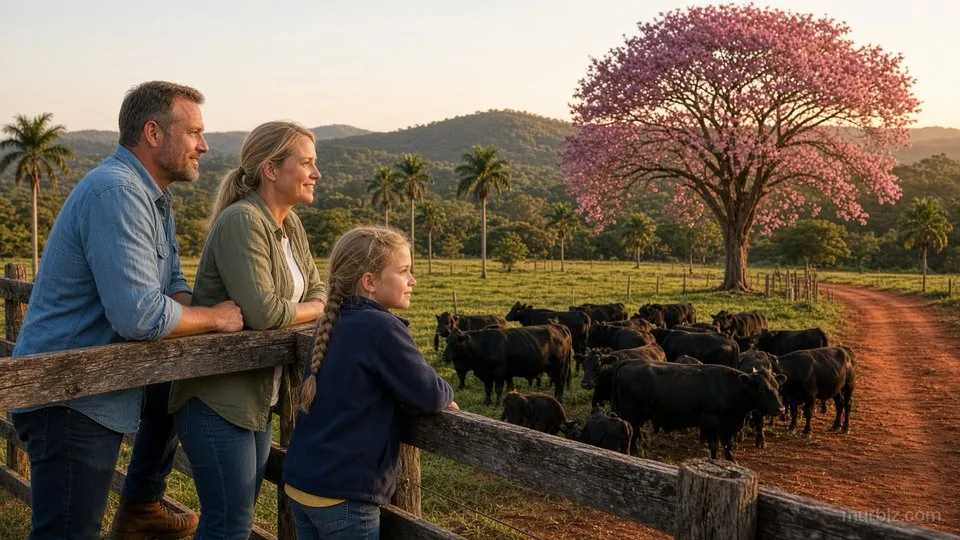
Shortly after six in the evening the light over the pastures turns golden, and the red dirt track to the corral glows as if someone had just painted it. It is August, the last month of winter in Paraguay: the days are dry and warm, the nights are cool, and at the edge of the pasture the pink lapacho blooms so densely that the branches almost disappear. Stefan leans on the wooden fence and counts the black cows crossing the pasture to the water trough. Julia stands next to him, and Marie has both hands on the top rail. She is nine and knows every cow by name, even if the cows know nothing about it.
"In Augsburg it is high summer now, and half of Swabia is at the lake," Julia says, laughing. "Here it is winter, it is 25°C, and the cows are having their calves. Marie thinks this is the better season."
Stefan is 45 and a mechanical engineer. Julia is 42; she grew up on a dairy farm in the Allgäu and studied agricultural science. Until 2025 their life looked like that of many families in Augsburg: a flat of their own, two careers, the primary school round the corner, the grandparents at the weekend. Today the family owns a farm of 92 hectares of pasture and forest in the hill country of the Paraguarí department, two hours' drive south-east of the capital, Asunción, with a herd of suckler cows and a Paraguayan foreman. Stefan already spends most of the year there. Julia and Marie still live in Augsburg: Marie is in fourth grade, and the family is letting this school year finish in peace. At the end of July 2027 the family deregisters in Germany, and from September Marie will study with a German distance-learning school, from the veranda of the farm.
Murblz supports the family all the way: residence permits for all three, bank accounts in Paraguay, the check and the purchase of the farm, a company for the cattle business and the plan for leaving German tax liability. Stefan and Julia agreed to tell their story in the middle of the move, so that other families can see the whole road with real figures, from the first idea to the first calf.
Why Paraguay, and why now
The idea came in the summer of 2024, one evening on the balcony. Stefan had read that since 27 June 2024 Germans can take a second citizenship without losing their German one. "Until then a second passport was a thought experiment for us," he says. "From that day it was a plan."
A plan B, as the two of them call it. Not a break with Germany and not an escape, more of an insurance policy: a second home, a second citizenship and land of their own. "My parents farmed all their lives," Julia says. "I always wanted animals and open space around me again. In Bavaria our savings would have bought a few hectares of cropland. Here it is 92."
They compared Uruguay, Argentina and Paraguay. Paraguay won for four reasons:
- Residence. Paraguay asks for no proof of income for temporary residence: besides the passport, the certificates and a police certificate with an apostille, a statement on the planned activity and an address in the country are enough. Permanent residence follows within two years, and three years after that foreigners can apply for citizenship, provided they have actually lived in the country during that time.
- Taxes. Paraguay taxes only income earned in Paraguay, at 8 to 10%. Income from abroad stays tax-free.
- Land. Foreigners buy land on the same terms as Paraguayans, and a hectare of pasture costs a fraction of a hectare in Bavaria.
- The Germans. German settlers arrived as early as the 19th century, and in the colonies in the south, such as Hohenau and Obligado, German is still spoken today. According to official figures, 1,652 Germans received a residence permit in Paraguay in 2025; only Brazil and Argentina sent more people.
For a comparison of the two countries, see our article Paraguay vs Uruguay.
A scouting trip in the Easter holidays of 2025
In the Easter holidays of 2025 they flew to Asunción for the first time, the three of them, with one change and a long list. April is autumn in Paraguay: around 28°C in the daytime, mild in the evening, the great heat over. In ten days they drove a good thousand kilometres, south to Itapúa, where the old German colonies are, and back through the hill country of Paraguarí.
Itapúa is the most German department in the country. According to official figures, one in five of Paraguay's residents born in Germany lives there, and there are German bakeries and clubs. The family liked it very much but bought elsewhere. "Around the colonies it is soy country: the land is cropland and priced accordingly," Stefan says. "For cattle and for our budget Paraguarí fitted better. And from there it is two hours to the airport instead of more than five." For Julia and Marie, who travel between two continents until the summer of 2027, that was the deciding argument.
Paraguarí is green and hilly, with streams, small lakes and forest on the slopes. Cattle graze the pastures. The farms are much smaller than the vast ranches, or estancias, in the west of the country, and farms of 50 to 300 hectares come onto the market regularly. Stefan and Julia viewed three of them on that first trip. They bought none, but after the trip they knew exactly what they wanted.
Residence: three temporary cards instead of the investor route
They applied for residence in the summer holidays of 2025, again the three of them. The applications were filed by Murblz specialists together with partner lawyers in Paraguay, and each applicant had to appear in person at the migration authority in Asunción, Marie too, with both parents signing for her. The family had prepared the documents in Augsburg: birth and marriage certificates with an apostille and police certificates for Stefan and Julia. In Asunción a sworn translator put everything into Spanish, and the family obtained the certificates from Interpol and the National Police. After the application the authority issued all three a provisional card valid until the decision, and in November 2025 the temporary residence permits were ready. They are valid for two years.
In fees, temporary residence now costs $509 (2,926,925 guaraníes) per person, a little over $1,500 for the family. There is a faster route: investors in Paraguay receive permanent residence straight away. It did not suit the family for three reasons. When they applied, they did not yet own a single square metre in Paraguay. For an investment in a business, the Ministry of Industry and Commerce requires at least $70,000 per applicant, an approved business plan and at least five permanent jobs. And the law names the exception only for the investor, with no mention of a spouse or children. "A suckler herd on 92 hectares needs a good foreman, not five employees," Stefan says. "We did not want to invent anything."
The switch to permanent residence is due in August 2027, shortly after the move and within the last three months of the temporary cards. Since 6 July 2026 the migration authority has required proof of solvency for it under one of twelve categories, among them farmers and cattle breeders as well as family members. Stefan proves his income through the farm: the cattle sales go through the family's own company in Paraguay, which has kept books and filed tax returns since 2026. For the switch Julia proves the marriage instead of an income, and for Marie one parent with permanent residence is enough. Until then one rule applies that many people underestimate: anyone on temporary residence who spends more than a year at a stretch abroad can have the status revoked by the migration authority. The holidays on the farm keep Julia's and Marie's cards valid along the way.
How the temporary route works step by step is explained on our page Paraguay temporary residency, and the investment route on the page Paraguay permanent residency.
92 hectares: how they found the farm
In October 2025 Stefan flew to Paraguay alone and stayed five weeks. With a specialist from the Murblz partner network he viewed eleven farms of 60 to 180 hectares, most of them in the Paraguarí department. Julia had written the list of criteria, and it was short:
- Water all year: a stream that flows even in the dry winter, and a watering hole for the animals.
- A track that stays passable after rain. In the rain the red earth turns as slippery as soap.
- Fences and a corral in a state that can be repaired.
- A house with a power connection, simple but habitable.
- A clean title with no seizure, no mortgage and no boundary dispute.
- Enough forest. Under Paraguay's forestry law, a quarter of any rural property over 20 hectares must remain natural forest; where it is missing, the owner has to reforest 5% of the area. In the east of the country, no forest has been allowed to become pasture or cropland since 2004, and the law in force runs until December 2030. Anyone buying a farm here buys the pastures as they are.
The eleventh farm was the right one: 92 hectares on a stream that comes down from the hills. 64 hectares are pasture, a good half of it sown with brachiaria grass; 24 hectares of forest run along the stream and up the slope; and four hectares hold the farmhouse, a smaller house for the foreman, the corral, sheds and a few orange trees. The farmhouse dates from the nineties and has thick white walls, a tiled roof and a wide veranda. The previous owner, a cattle breeder in his mid-seventies, wanted to move to the city to be near his children. "He showed us every corner, the bad ones too," Stefan says. "Where the fence leans, where the stream floods in summer. That is when we knew we were in the right place."
In Bavaria this would be a large farm; in Paraguay it is a small estancia. The price was $3,500 per hectare, $322,000 in total (around 1.9 billion guaraníes) for the land, the houses and the fences. That is a usual price for the area: in the south of Paraguarí, grazing farms are offered from about $2,500 per hectare, and with a good farmhouse, sown pasture and a stream that carries water all year they cost more. Closer to the capital, in the Cordillera department, prices start at around $6,700 per hectare.
The purchase at the notary in Asunción
In January 2026 Stefan signed the preliminary contract and paid a 10% deposit. Before the notary appointment, the notary and Murblz's partners checked everything that can become expensive later: the title for seizures and mortgages; the boundaries and the area, both kept since January 2026 in a single registry at the Supreme Court; the municipality's certificate that the property tax had been paid; and whether everyone who had to sign would sign. In this case that included the seller's wife.
The appointment fell in the carnival holidays of 2026. Marie stayed with her grandparents in the Allgäu, and Julia flew to Asunción alone. Stefan had been in the country since the preliminary contract anyway. February is high summer there: in the notary's office the ceiling fan turned, and mango trees stood outside the window. The deed of sale is in Spanish, and a sworn interpreter translated every paragraph.
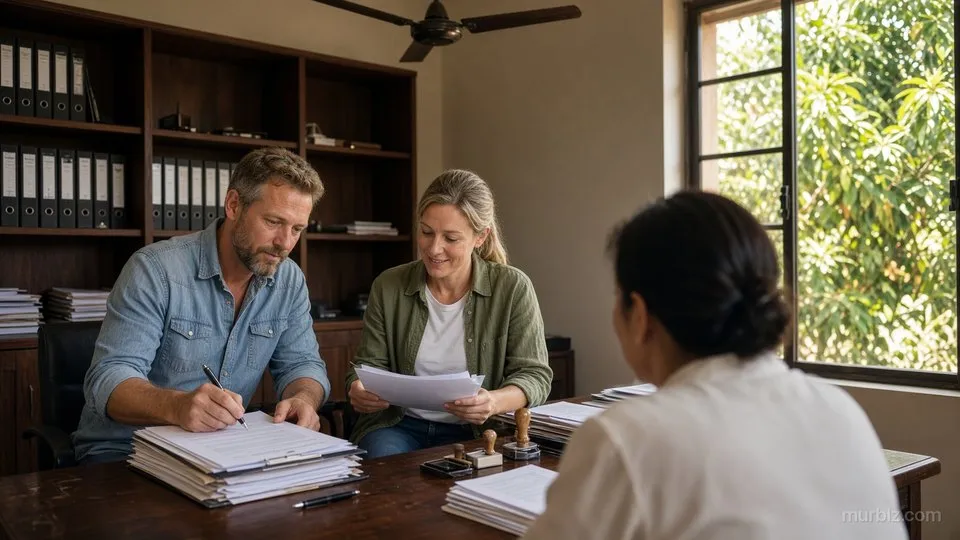
The family paid the balance from their own account at one of the largest banks in Paraguay, which Murblz had opened for them in 2025. For such a large sum the bank wanted to know exactly where the money came from. "The contract for Stefan's share in his firm answered every question," Julia says. At the end of 2025 Stefan had sold his 25% stake in the engineering firm to his two partners, and most of the purchase price came from that sale. How to move larger sums cleanly is explained in our article how to send money to Paraguay.
After the signing the notary filed the deed with the registry, and in April 2026 the family was registered as the owner. The notary, the registry and the fees came to around $9,700, about 3% of the purchase price. The family pays property tax to the municipality every year: 1% of the official cadastral value, which is far below the purchase price. In the east of the country, untouched natural forest can even be fully exempt from property tax, and the forest by the stream stays as it is anyway.
A farm in Paraguay is checked before the deposit
Mistakes cost more than the notary: a title with a seizure or a mortgage in the public registry, boundaries that do not match the cadastre, too little forest for the legal reserve, the seller's unpaid property tax or a herd without registration. Murblz support takes these risks off your hands: we check the farm before the deposit, handle the purchase from the preliminary contract to registration, set up the company, open the accounts and apply for residence for the whole family, with locally licensed partners. We guarantee professional work and a transparent process, and in most cases a result on the first filing.
The cost of support depends on the route, the farm and the size of the family. A consultant calculates it in the chat.
The herd: 40 suckler cows and a bull
Before the first animals arrived, Stefan spent two months mostly as a handyman. With Ramón, the new foreman, and two helpers from the village he set new posts, tightened the wire, rebuilt the race at the corral and installed a solar pump at the stream that fills a trough on the upper pasture. In April 2026 the cattle arrived: 40 pregnant Brangus cows, examined by the vet and bought at a livestock auction in the region, plus a Brangus bull for the next breeding season. A pregnant cow cost $1,300 (7,450,000 guaraníes), and the bull $3,400 (19,500,000 guaraníes). Breeding cows are expensive in Paraguay at the moment: many breeders are keeping their cows to raise more calves, and anyone buying breeding stock pays more than for slaughter cattle.
Ramón is 58 and has worked on estancias all his life. He lives with his wife in the second, smaller house on the farm and knows every neighbour and every disease a cow can catch. He is properly employed and registered with social security, as the law requires. Ramón earns $790 (4,500,000 guaraníes) a month, well above the legal minimum wage of $529 (3,044,000 guaraníes), and lives rent-free. On top of the wage the farm pays 16.5% in social security contributions and Ramón himself pays 9%, and in December, as everywhere in Paraguay, there is a thirteenth monthly salary. "Without Ramón we would not have got through the first months," Stefan says. "I bring the engineering, he brings the knowledge."
The pasture has its paperwork too. The farm has a registration number with Senacsa, the animal health authority, and the company's brand is registered with the Supreme Court, which keeps the livestock brands in Paraguay. Without a registered brand there are no transport papers, and no animal leaves a pasture without a movement permit: for the transport from the auction Senacsa issued a certificate valid for 15 days. The herd is vaccinated twice a year: in February and March all the cattle against foot-and-mouth disease, and in May and June the calves once more; Paraguay is recognised as free of the disease with vaccination. The district's animal health commission gives the injections, and the owner pays for them. Female calves also get the brucellosis vaccine at three to eight months, and since 2025 every calf receives an official ear tag and an entry in the national animal register.
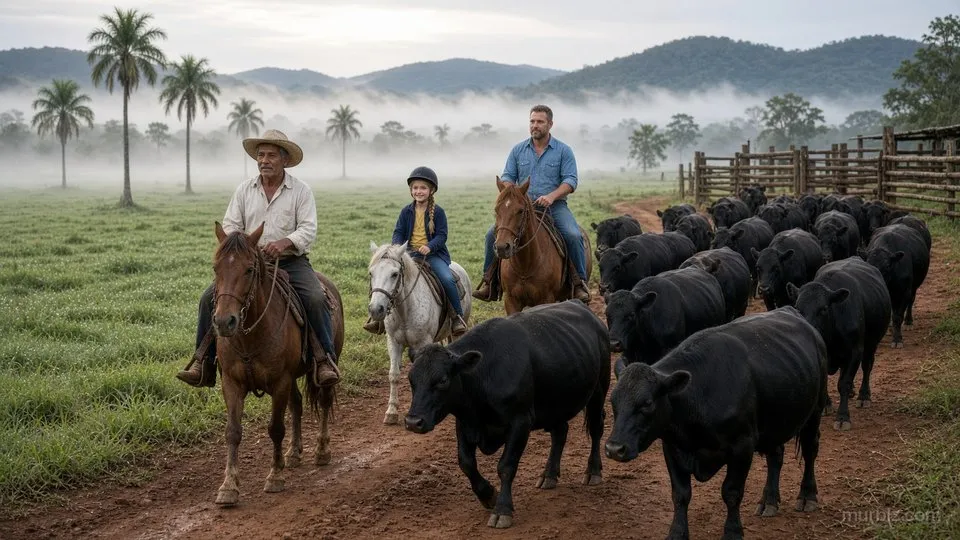
In the Whitsun holidays of 2026 Julia and Marie came to their own farm together for the first time. Late May is late autumn in Paraguay: the mornings are cool, and the mist over the pastures lifts only around ten. On one of those mornings they drove the herd to the pasture by the stream, Ramón in front, Marie in a riding helmet on the grey pony Ramón had picked for her, and Stefan behind. "On the third day she got up before breakfast without anyone waking her," Julia says. "In Augsburg I can hardly get her out of bed at seven."
The first calves
The cows were three to five months pregnant when they were bought, and the arithmetic worked out. The first calf arrived on 9 August 2026, a week after Julia and Marie had landed for the summer holidays. Marie saw it from the fence in the evening sun, less than twenty metres away, and named it Lapacho, after the tree it lay under. By the end of October 37 calves had been born, 19 bull calves and 18 heifer calves. Two cows lost their calves, and one is still to calve.
The cows calve outside on the pasture, without a barn and almost always without help. Ramón rides the pastures morning and evening, counts the calves, disinfects the newborns' navels and marks them. In those weeks Marie rode with him almost every evening. In a notebook she wrote down every calf: the date, the mother, bull or heifer, and a name. From calf number twenty she ran out of names, and since then the calves have been named after footballers.
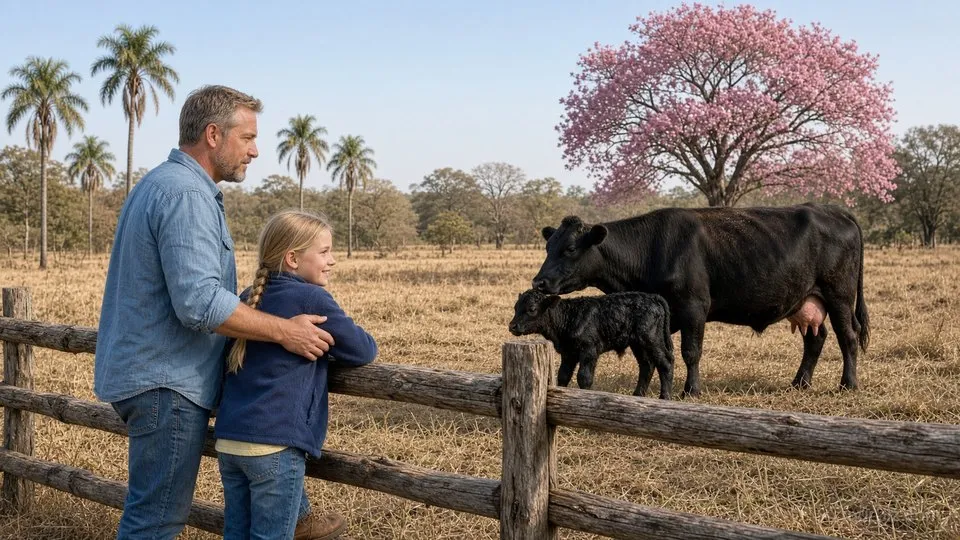
August is dry in Paraguarí. On the natural pasture the grass turns yellow; only the sown brachiaria by the stream and around the house stays green for longer, and the cows get salt with minerals on top. It rarely gets cold, but on some nights the thermometer drops to a few degrees above zero. One morning in early July there was even hoarfrost on the pastures: in Paraguarí frost usually comes between late May and late July. Because the tropical grasses hardly grow in winter, Ramón had rested the upper pasture from April as a reserve for July and August. With the first thunderstorms in October everything turns green again within a few weeks. Most of the rain falls from October to April, and June to August are the driest months.
How the farm makes money
The business is as old as cattle farming itself: every suckler cow has one calf a year, the calves stay with their mothers for six to seven months and after weaning are sold to fattening farms, at an auction in the region or straight from the farm. Cattle are traded by live weight. In September 2026 a weaned bull calf of 170 kilos fetched around $710 (4.1 million guaraníes) at the auctions, and a heifer calf of 160 kilos around $620 (3.6 million guaraníes). Fatteners pay considerably more for a kilo of calf than slaughterhouses pay for a kilo of grown cow. The farm's first weaners go on sale in March and April 2027, and the family keeps the best heifer calves for its own herd.
No one gets rich on 92 hectares, and that was never the plan. In the first full year Stefan expects to sell around 18 bull calves, eight heifer calves and four older cows for slaughter. At September 2026 prices that comes to around $23,000 (130 million guaraníes). Ramón's wage, the vet, vaccines, salt, fences and bookkeeping cost around $19,000 a year, which leaves around $4,000 before tax. By 2028 Stefan wants to sow another 15 hectares of natural pasture with brachiaria, and after that the herd is to grow to around 55 suckler cows from its own heifer calves. "The farm should pay for itself and a little more," he says. "In the first years we will live mainly on the proceeds from my share in the firm. But every cow standing here is a piece of security that belongs to us."
The land belongs to Stefan and Julia; the herd and the business belong to a Paraguayan company that Murblz set up for them in March 2026. It has its own tax number and a business account, buys the vaccines and the salt, pays Ramón's wage and sells the calves. It pays 10% tax on its profit, and on the sale of live cattle only 5% VAT applies instead of the usual 10%. When Stefan and Julia pay out profits to themselves, another 8% is due as long as they are tax resident in Paraguay, and 15% otherwise. Julia collects the receipts for the bookkeeping, even from Augsburg. How the set-up works is described on the page company registration in Paraguay, and the company account on the page business account in Paraguay.
Taxes: a clean exit from Germany
It was not the farm that worried Stefan most, but the German tax office. "Tax law in Paraguay is straightforward," he says. "The real work is on the German side: you have to leave cleanly." Murblz specialists drew up the plan for it, and it rests on three rules.
First: tax liability ends with the home, not with the stamp at the registration office. Anyone who has a residence or their habitual abode in Germany is subject to unlimited tax liability there, on their entire worldwide income. A residence is any home a person keeps and uses; there is no minimum number of days. A spouse who is not permanently separated generally has their residence where the family lives. As long as Julia and Marie live in Augsburg, Stefan therefore remains fully taxable in Germany too, however many months he spends on the farm. The family leaves together: the flat was sold in September 2026, the buyers get the keys at the end of July 2027, and all three deregister that same week. They pay no tax on the gain from the sale, because they live in the flat themselves until they move out. They have thought about the grandparents as well: a room of one's own with one's own key, ready at any time, already counts as a residence. In future they will stay in the Allgäu as guests.
Second: settle company shares before leaving. Anyone who has been subject to unlimited tax liability in Germany for at least seven of the last twelve years and holds at least 1% of a limited company pays exit tax on leaving. The tax office treats the shares as if they had been sold and taxes a gain that never reached any account. Since 2022 this has applied whatever the destination. Stefan sold his stake to his partners while still tax resident in Germany. He pays tax on the real gain in Germany in the normal way, on 60% of it under the partial income method, and the money for the tax is already in the account. When he leaves, he will no longer hold shares in a German company. The exit tax does, however, also cover the family's own Paraguayan farm company: for its shares, leaving counts as a sale at market value. Only the increase in value since the company was founded in March 2026 is taxed, 60% of it, and Murblz specialists have already budgeted for that amount.
Third: leave nothing big behind in Germany after the move. Germans who move to a low-tax country remain subject to extended limited tax liability for ten years after leaving if they keep substantial economic interests in Germany: for example, at least 1% of a German limited company, German income of more than $70,000 (€62,000) a year or more than 30% of all income, or assets producing German income, say in a German account, of more than $180,000 (€154,000) or more than 30% of total assets. Tax is then due only in years when German income exceeds $19,000 (€16,500). With a top income tax rate of 10%, Paraguay counts as such a country. Because the company stake and the flat have been sold, and the money from both sales will not sit in German accounts after the move, the rule does not apply to the family. For inheritance and gift tax, German citizens remain fully liable for five years after leaving, on all their assets, the farm in Paraguay included. The same tax-free allowances apply as for residents: $450,000 (€400,000) for a child.
Then there are child benefit, health insurance and the pension. Child benefit, $290 (€259) a month in 2026, ends with the month of departure, and the family must notify the child benefit office itself, straight away. Statutory health insurance also ends with the move, and with it Marie's cover under her parents' policy. There is no social security agreement with Paraguay, and the German insurer pays practically nothing there. That is why Stefan already has private insurance on the farm. From the move there will be private health insurance for all three, plus a dormant policy: for around $96 (€85) a month per person it keeps the way back into statutory health insurance open. Stefan and Julia can also pay voluntarily into the German state pension from Paraguay, from $130 (€112.16) a month in 2026 and a little more from 2027. What else to watch for with deregistration, health insurance and the pension is summed up in our checklist for leaving Germany.
The Paraguayan side is simpler. Residents of Paraguay pay 8 to 10% only on income from Paraguay, and income from abroad stays tax-free. There is no comprehensive double taxation agreement between Germany and Paraguay, only an arrangement for airlines. The Paraguayan tax authority issues a certificate of tax residence on request. For it, Stefan presents his Paraguayan identity card and the migration authority's record of his entries and exits for the year in question. Banks ask for the certificate, and with it, payouts from the farm company cost 8% instead of 15%. For the German tax office, by contrast, the only thing that counts is whether the family still has a residence in Germany. More on this on our page taxes in Paraguay.
The family's timetable looks like this:
| When | Step |
|---|---|
| End of 2025 | Stefan sells his stake in the engineering firm to his partners, and the gain is taxed in Germany |
| September 2026 | Notarised contract for the Augsburg flat, handover to the buyers after the school year |
| June 2027 | Notify the health insurer, take out the dormant policy and private health insurance for all three from the day of departure |
| End of July 2027 | Last day of school, handover of the flat, deregistration of all three at the Augsburg registration office (free of charge, also online), notice to the child benefit office |
| August 2027 | Application for permanent residence in Paraguay |
| End of 2027 | Application for the certificate of tax residence in Paraguay, with the record of entries and exits |
| By 31 July 2028 | Last German tax return, for 2027. Income from Paraguay after the move is not taxed in Germany, but it raises the tax rate on that year's German income |
For post from the tax office after the move, the family has named Julia's brother in Kempten as their authorised recipient. "Most mistakes don't happen in the big plan, but in the small letters," Julia says.
School: primary school first, then distance learning
The question that occupied Julia longest was not the farm but Marie. In Bavaria, every child whose habitual abode is there must attend school, and compulsory schooling in Germany means going to school: teaching at home is not allowed, not even with a distance-learning school's materials. That route opens only once the child lives abroad with the family. Deregistering at the registration office is not enough on its own; what counts is where the family's life is actually centred. As long as Marie lives with Julia in Augsburg, she goes to primary school. Changing schools in the middle of the school year was out of the question anyway. "Marie has her friends and her teacher in Augsburg, and fourth grade is an important year," Julia says. In May 2027, like every fourth-grader in Bavaria, Marie will get her report for the move to secondary school. It will not be needed for now, but it will be kept: if the family ever comes back, it records Marie's results at the end of primary school.
From September 2027 Marie will study with a state-approved German distance-learning school for children abroad. The country's German school abroad is in Asunción, two hours' drive from the farm and so too far for every day. State-approved means that a state body has examined the course; the distance-learning school itself is not a state school. At the start of the school year a parcel arrives with workbooks and textbooks. Marie works through them lesson by lesson according to a plan and submits assignments online for every subject, which the school's teachers mark and grade. There are no fixed lesson times, and a school day takes four to five hours. Julia supervises the lessons and needs no teacher training for that. Depending on the provider, a school year costs from around $4,700 (€4,200), workbooks, postage and marking included. At the end comes a report from the distance-learning school, but not a state one: if Marie ever returns to Bavaria, the receiving school decides which year she joins, and a grammar school only after an entrance exam and a trial period.
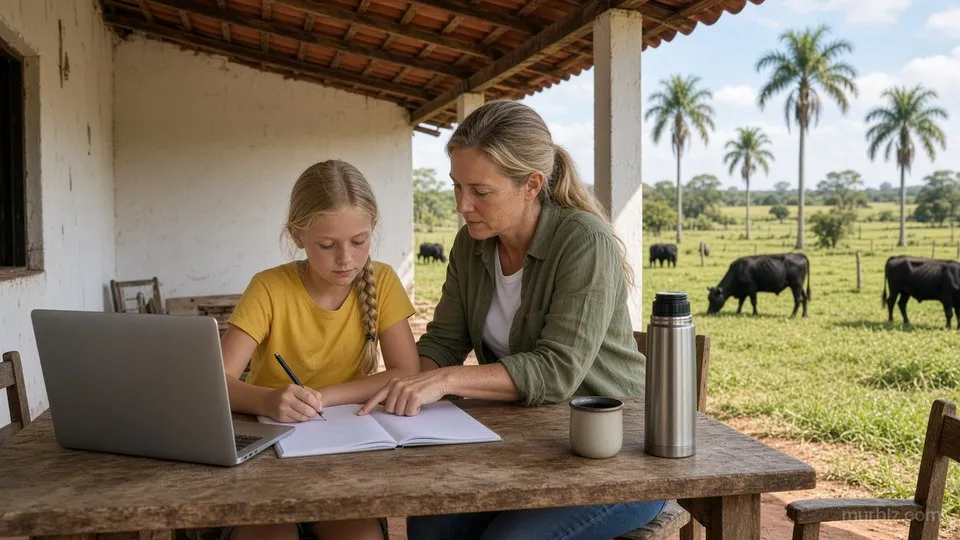
They have already tried it out. In the summer holidays of 2026 Julia and Marie sat on the veranda every morning for two hours with the distance-learning school's materials, maths and German, and then went to see the calves. The internet comes via a satellite dish on the roof and is enough for video calls and learning platforms. Marie has been learning Spanish online twice a week since 2025 with a teacher from Asunción, and Ramón is teaching her the first words of Guaraní, Paraguay's second official language.
Holidays on the other side of the seasons
Until the move, the family lives by two calendars: the Bavarian school holidays and the seasons of the southern hemisphere. That produces a logic of its own. The Whitsun holidays fall in Paraguay's late autumn, with mist in the mornings, and the summer holidays in the dry late winter, when the lapacho blooms. Christmas 2026 will be the family's first on the farm, in high summer at well over 30°C. Marie has already decided that this year's Christmas tree will be a palm.
The journey takes around a day from door to door: by train to Munich airport, one change in Europe or in Brazil, then a two-hour drive from Asunción to the farm. So for Marie only the long holidays are worth it: Easter, Whitsun, summer and Christmas. The All Saints' and carnival holidays last only a week, too short for a day's travel each way. Flights are booked strictly by the holiday calendar, because in Bavaria the school lets a child start the holidays a day early only in justified exceptional cases, and parents who keep a child off school without permission risk a fine. In the holidays a return flight costs from around $1,200 (€1,000) per person. And because Marie has held a temporary residence permit for Paraguay since November 2025, she needs her father's consent every time she leaves the country without him: before each departure Stefan signs the travel authorisation at the justice of the peace in the neighbouring town, and there is no fee for it.
In between, a video call holds the family together, every day at the same time. Since October 2024 Paraguay has kept the same time all year round, three hours behind UTC. So the gap to Germany changes only with the German clock change: five hours in the German summer, four in winter. Since 25 October the tablet in Augsburg has rung at half past five, as it gets dark outside. On the farm it is then half past one, early afternoon.

What the move costs
Stefan keeps a spreadsheet of everything, as befits an engineer. The main expenses from the first flight in April 2025 to the end of October 2026:
| Item | Amount |
|---|---|
| Flights: 13 return trips Munich–Asunción since April 2025 | $16,000 (€14,000) |
| Hotels, rental cars and travel in Paraguay in 2025 | $6,000 (€5,300) |
| Residence for three: fees, certificates, apostilles, translations | $2,000 |
| Farm: 92 hectares with houses and fences | $322,000 |
| Notary, registry and fees | $9,700 |
| Fences, race, solar pump and trough | $8,000 (46,000,000 guaraníes) |
| 40 pregnant Brangus cows | $52,000 (298,000,000 guaraníes) |
| Brangus bull | $3,400 (19,500,000 guaraníes) |
| Two horses and a pony with saddles | $2,500 (14,000,000 guaraníes) |
| Renovation and furniture | $8,900 (51,000,000 guaraníes) |
| Used pick-up | $26,000 |
| Total | $456,500 |
And what the farm and life there cost every month:
| Running costs | Per month |
|---|---|
| Ramón's wage with social security and the 13th salary | $980 (5,617,500 guaraníes) |
| Vet, vaccines, mineral salt and ear tags | $300 (1,700,000 guaraníes) |
| Fences, repairs and spare parts | $170 (950,000 guaraníes) |
| Company bookkeeping | $120 (690,000 guaraníes) |
| Diesel, electricity and satellite internet | $260 (1,480,000 guaraníes) |
| Food, household and Stefan's private health insurance | $410 (2,350,000 guaraníes) |
| Total | $2,240 |
Dollar amounts use the official rate for 2026, 1.1177 dollars per euro, and the 2026 rate of 5,754.5 guaraníes per dollar, rounded up. What else life in Paraguay costs, from rent to the supermarket, is shown in our article cost of living in Paraguay.
Plan B: permanent residence and a second passport
The plan B that started it all has two parts. The first is permanent residence, which all three will apply for in August 2027. The status has no expiry date; only the card is renewed every ten years. Absence costs the status only to someone who lives abroad for more than three years at a stretch without good reason. "Even if one day we had to go back to Bavaria for a while, the door to Paraguay would stay open for us," Stefan says.
The second part is the Paraguayan passport. Naturalisation is open to anyone who is at least 18, has actually lived in the country for three years with permanent residence, works in a profession or trade and is of good character. The Supreme Court decides on the application, and it includes a written test in Spanish: 21 points out of 30 are needed. The three years count from the decision on permanent residence. If it comes as planned around the turn of 2027 and 2028, Stefan and Julia will apply at the beginning of 2031. The court procedure takes nine months to two years, and they expect the passport around 2032.
The two of them know exactly how seriously the court takes the word "actually". Anyone who spent more than three months a year abroad in the three years before applying, or who has no real address in Paraguay, is turned down. So the visits to the grandparents in the Allgäu stay short, two or three weeks a year. In return, the grandparents have promised to come to the farm in the German winter, when it is summer in Paraguay.
Marie can apply only once she is 18. Until then she has her own permanent residence, and whether she also wants the Paraguayan passport at 18 will be her own decision.
All three keep their German passports. Since 27 June 2024 Germans no longer lose their citizenship when they take a second one, and Paraguay does not ask for proof that the old passport has been given up. At naturalisation one swears allegiance to the Republic of Paraguay, and that does not affect German citizenship: renouncing it requires a written declaration to the German authority and its approval. One rule matters for the time after naturalisation: anyone who later voluntarily takes another, new citizenship or lives abroad for more than three years without good reason risks losing the Paraguayan one. German citizenship does not count, because it was there before.
Our page Paraguay citizenship describes the whole route. How the test works is shown in the article naturalisation exam in Paraguay, and where you can travel without a visa on a Paraguayan passport in the article visa-free countries with a Paraguayan passport.
What Stefan and Julia advise other families
After a year and a half between Augsburg and Paraguay, the two of them have a list of their own for anyone planning a similar route:
- See the region in two seasons. In April the pasture is green, in August yellow and dusty, and a track that is dry in winter is under water after a summer thunderstorm. "If you have seen a farm only once, you don't know it," Julia says.
- Water first, then the price. A stream that flows even in dry August is worth more than any discount. "A cheap hectare without water is the most expensive one," Stefan says.
- Sort out company shares before leaving. Anyone with a stake in a limited company should clarify with Murblz specialists what happens on leaving before the moving date is fixed, not after.
- Fences first, then the herd. Cattle find every gap. The two months spent on fences, the corral and the trough before the first cow arrived were the farm's best investment.
- Pay the foreman well and register him. On a small farm an experienced foreman is half the battle. He earns more than the minimum wage and is registered with social security.
- Plan by the school calendar. Every trip with Marie fell in the Bavarian school holidays, and the move comes only after primary school. "A child shouldn't be pulled out of class in the middle of the year just because the parents are in a hurry," Julia says.
- Start Spanish early. Stefan and Julia have been learning since 2025, and so has Marie. At the notary an interpreter still helped, but at the cattle auction and with the neighbours every word of your own counts.
How Murblz helps families move to Paraguay
Murblz specialists and their local partners supported the family at every step, and they work the same way with other families:
- Residence: temporary cards for the whole family and a timely switch to permanent residence, see Paraguay temporary residency. The direct route through an investment is described on the page Paraguay permanent residency.
- Accounts: a personal account at a Paraguayan bank, see personal account in Paraguay.
- Farm or house: checks on the title, cadastre, forest and taxes, and support from the preliminary contract to registration, see property in Paraguay.
- Company: setting up the company and a business account, see company registration in Paraguay and business account in Paraguay.
- Taxes: a plan for leaving German tax liability and for tax residence in Paraguay, see taxes in Paraguay.
- Passport: preparation for naturalisation and the exam, see Paraguay citizenship.
The cost of support depends on the family and the route chosen. A consultant will calculate it in the chat.
The life they are moving for
A Saturday evening at the end of August 2026. The lapacho is in bloom by the corral, and Stefan lays the meat on the brick grill for an asado, the Paraguayan barbecue, because there is something to celebrate: twelve calves are already out on the pastures. Julia hands Marie a plate, and Ramón sits on the bench with his tereré, the cold mate tea without which no afternoon passes in Paraguay. Marie tells him for the third time that Lapacho ate grass for the first time today. The sun sets over the hills, and the fairy lights come on above the grill.
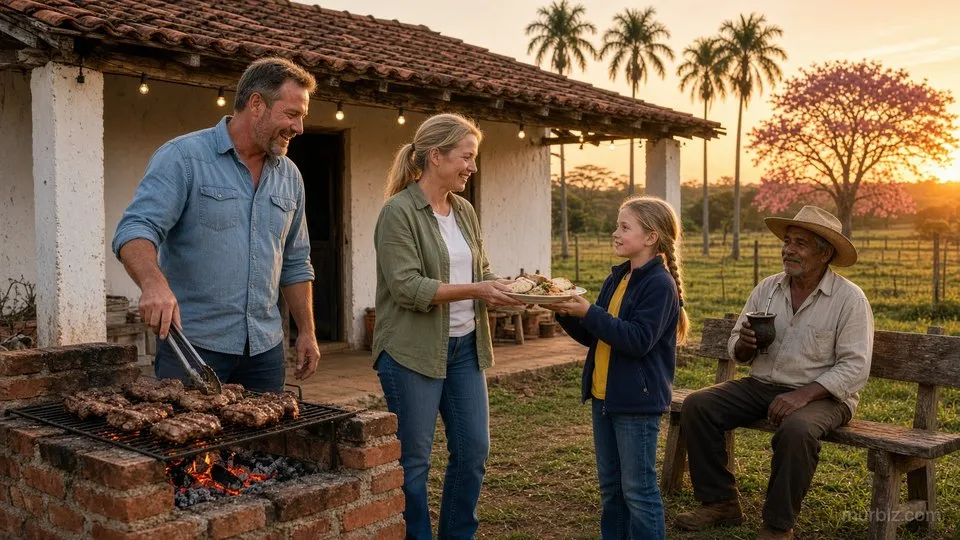
"For a long time we thought we were emigrating because of the taxes or because of plan B," Stefan says. "In truth, it's because of evenings like this." Julia nods: "And because Marie is outdoors here every day and knows where her food comes from."
In just over two years the family has covered most of the road: residence, a bank account, the farm, the company, the herd and a plan for leaving German tax liability. In the summer of 2027 comes the last step, the actual move. Murblz specialists were at their side at every step. Your family can do the same: the road to Paraguay is made of the same steps, and each one has a deadline, a list of documents and a person responsible for it. Tell a Murblz consultant who is moving and what you dream of, whether a farm, a house in town or a quiet life in the countryside. The consultant will review your case and plan the move step by step. The first consultation is free. Plan our move to Paraguay
FAQ
Can foreigners buy land in Paraguay?
How much does a hectare of pasture cost in Paraguay?
How many cattle can 92 hectares carry?
What taxes does a cattle farm pay in Paraguay?
When does German tax liability end when you move to Paraguay?
How long does it take to get a Paraguayan passport?
Do Germans lose their citizenship if they become Paraguayan?
How do German children study in Paraguay?
What is the time difference between Germany and Paraguay?
Services
Murblz services in Paraguay
A passport or residence permit opens the door, but life behind it is awkward without a bank account and a roof over your head. Murblz specialists help with the account, property and company in the same country. The quote is fixed in writing before work starts.
Don’t want to figure this out alone?
We handle the whole process end to end: we check your documents, match a program to your situation and give you honest timelines and costs. Ask your question in the chat: the free consultation starts right here. Legal representation before authorities and courts is handled by Murblz specialists together with locally licensed partners.
The Murblz consultant replies straight away in the chat on this page. Describe your situation and we will work it out together.
Free consultationWhat happens next
- An expert reviews your situation and goal.
- We contact you the way you prefer and answer your questions.
- You get a work plan, honest timelines and a written quote.
How to send money to Paraguay in 2026 →
We can help with the transfer: ask in the chat.
Programs