How to choose a neighborhood to live in abroad: 12 criteria and a week on the spot
Neighborhoods within one city differ more than cities do: in income, noise, summer nights and tourists. Here are 12 signs to check a neighborhood before you rent or buy, and where to find real figures for each.
In short
- In Barcelona, income per resident differs 3.7-fold between neighborhoods: $56,000 and $15,000 a year (2023).
- A July night in central Madrid is on average 2.2 °C warmer than on the edge of the city by the airport.
- More than 20% of people in Europe live with transport noise at harmful levels (2025).
- 23% of employed people in the EU work from home at least sometimes: for them the neighborhood matters more than the city.
- 12 signs of a neighborhood can be checked before renting, using open data from city halls, statistics offices and weather services.
In detail
Why the neighborhood matters more than the city
You choose a neighborhood abroad by 12 checkable signs: street noise, transport, schools and playgrounds, green space, summer nights, rent, tourist pressure and who lives there. In 2026 almost all of these figures are open at city halls, statistics offices and weather services. Start with the neighborhood: the gap inside one city is often wider than between cities.
Barcelona is a good example. According to the city council, in 2023 disposable income per resident was $56,000 (49,258 euros) a year in Les Tres Torres and $15,000 (13,355 euros) in Ciutat Meridiana, a 3.7-fold gap. On 1 January 2026 foreign nationals made up 68% of residents in the Gothic Quarter and 9% in Canyelles. Same city, same metro and same taxes, yet daily life in these areas is very different.
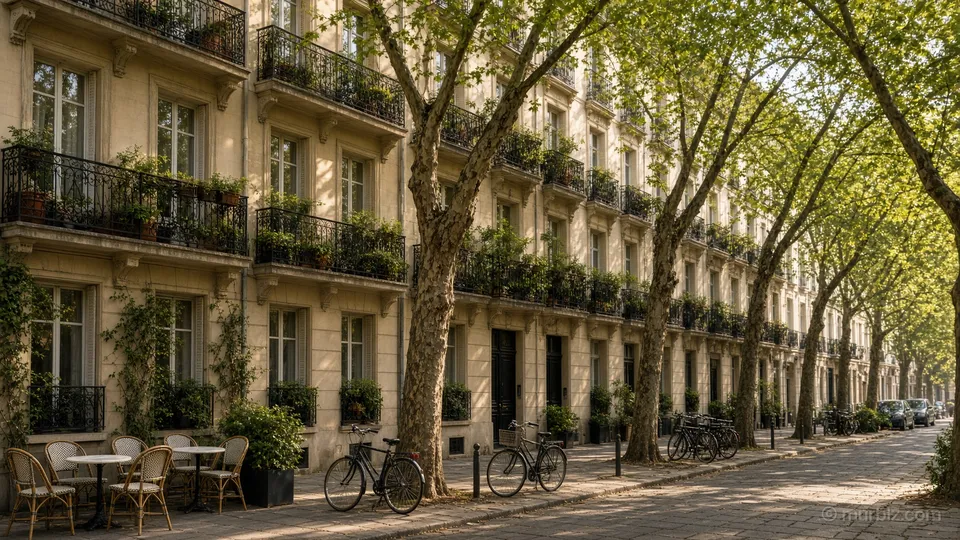
For people who work from home, the neighborhood matters even more. According to the statistical office of the European Union, in 2025 23% of employed people in the EU worked from home at least sometimes, and 22.7% of self-employed people without staff did so usually. When there is no office to commute to, almost nobody crosses the city for a coffee. An ordinary day happens within a 15-minute walk of home: the shop, the gym, the park, the café with a laptop.
That gives a simple test for any relocation advice. "Move to Lisbon" means little without a short list of neighborhoods and who each one suits. The city sets your visa, taxes and language. The neighborhood sets what an ordinary Tuesday looks like.
Where to start: your own list of criteria
The hardest part is knowing what you actually need. Someone who has lived in two or three similar cities usually knows less about their habits than they think. There is nothing to compare with: a quiet courtyard or a boulevard full of cafés, life by the sea or in an old center, walking everywhere or driving. So a blind choice often ends up close to random.
Two things help. The first is short stays in different kinds of neighborhoods in one city: a week by the sea, a week in the old center, a week in a new district next to a park. The second is an honest list. Write down 5-7 things you cannot be happy without and 3 things you will not put up with. The first become weights, the second become hard conditions.
Must-haves and nice-to-haves
Must-haves rule neighborhoods out at once: a rent budget, a school within 15 minutes for your child, a metro station nearby if you have no car. Nice-to-haves do not rule anything out, they add points: more green space, closer to the sea, more cafés. Mix the two lists and it is easy to drop a great neighborhood over a detail or to accept the wrong one for a nice view.
- Family with children: schools and nurseries, playgrounds, a park, a health center, quiet evenings, few tourists.
- Remote work: cafés and coworking spaces, quiet days, transport, shops and sport nearby, an international community.
- Retirement: level streets without steep climbs, doctors and pharmacies nearby, green space, quiet, a mild winter.
- Study and early career: lower rent, universities and transport, bars and restaurants, people your age.
- Life with a dog: large parks, dog areas, quiet streets.
The same figure is a plus for some and a minus for others. A street full of bars is a joy for a couple without children and sleepless nights for a family with a baby. So for nightlife, tourist pressure and distance to the center, it matters not only how much you care but in which direction.
Let us check whether you qualify
Describe your situation in the chat and we will tell you right away which option is yours.
12 signs that show whether a neighborhood suits you
We collected the signs people ask about most often in search and on the forums of those who have moved, and found an open source for each. The first five matter to almost everyone, the rest depend on why you are moving. We went through 50 discussions by people who moved in 2023-2026: housing costs come up in 37 of them, foreigners and community in 28, the sea in 26, and shops and everyday needs within walking distance in 23.
| Sign | What it shows | Where the figure comes from |
|---|---|---|
| Street noise | sleep and rest at home | the city's strategic noise map |
| Transport | metro, train or tram within 10 minutes | transport maps, open maps |
| Everything nearby | supermarket, pharmacy, market, health center on foot | open maps, registers of health centers |
| Green space and the sea | walks, cooler summers, room for children and dogs | open maps, city data on parks |
| Summer nights | how well the area cools down after a hot day | weather service stations in the city |
| Schools, nurseries, playgrounds | how easy life is for a family with children | education ministry registers, city lists of playgrounds |
| Nightlife and restaurants | evening noise or, the other way round, lively streets | open maps: bars, clubs, restaurants per km² |
| Tourist pressure | crowds, suitcases at night, holiday flats in your building | registers of tourist accommodation |
| Safety | thefts and assaults per 1,000 residents | police statistics by district |
| Rent | what a flat of the same size costs | official rent indices, rental deposit records |
| Buildings | age, lifts, insulation and soundproofing | housing census, land registry |
| Residents | income, age, children, share of foreign nationals | city population register, census, tax statistics |
Data for 2026.
Safety figures need one adjustment. Police record a crime where it happened, not where the victim lives. That is why the tourist center always shows more thefts per 1,000 residents: few people live there and many visit. When choosing a home, it is more useful to look at courtyards and quiet streets than at the main square.
Indirect signs: new buildings, coffee shops and playgrounds
Some things that matter in a neighborhood cannot be measured directly: who your neighbors are, how well the streets are kept, how safe it feels in the evening. But they leave visible traces in open data.
- New buildings. Many buildings from the last 20-25 years mean the area is growing and renewing: lifts, parking, insulation and air conditioning are more common. In older southern European buildings walls are often uninsulated and windows single-glazed, and you hear it in winter and in summer.
- Playgrounds and births. Families with children stay where prams are easy, nurseries and parks are close. Many playgrounds and a high share of children under 14 describe a calm residential area better than any brochure.
- Specialty coffee shops and coworking spaces. A sign that young professionals and remote workers live nearby. Gyms, good bakeries and evening life are usually close.
- Embassies, consulates and international schools. They choose calm, well-off areas with good security. Foreign families on high incomes tend to settle around them.
- Education and age of residents. The share of adults with a university degree and the average age show who your neighbors are: students, young families or retirees.
- Income per resident. Linked to the level of shops and services, and to rent.
No single sign decides on its own. Many coffee shops and consulates nearly always mean high rent too. Look at the combination: an area that has playgrounds, transport and quiet all at once is rarer than it seems, and it is worth searching for on purpose.
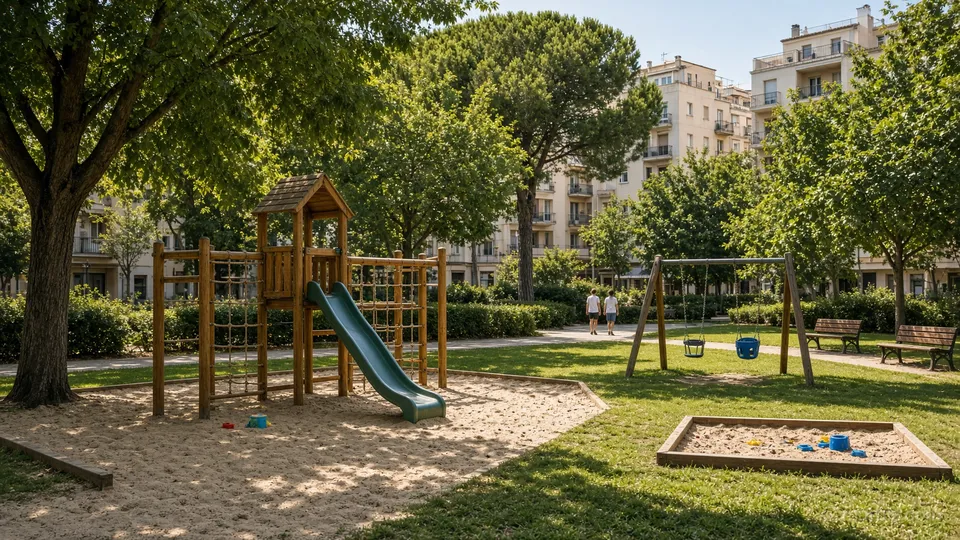
If you are moving with children, check the school before choosing the flat. In Spain, admission to a state school gives priority to families living close to it, and applications for the next school year are made in spring. So the school comes first, then a lease nearby.
We will review your situation for free
Describe your task in the chat and we will tell you where to start.
Why city rankings hardly help you choose a place
Rankings of the best cities to live in measure city averages: safety, healthcare, economy, environment. Cities of northern and central Europe often come out on top: excellent services, but a short winter day. For a tourist or an investor that is a fair score. For someone who will live there, it hides two things: the gap between neighborhoods and the amount of sunlight.
Day length can be calculated exactly. On 21 December Helsinki gets less than 6 hours of daylight, while Lisbon gets almost 9.5 hours.
| City | Daylight on 21 December | Daylight on 21 June |
|---|---|---|
| Helsinki | 5 h 49 min | 18 h 56 min |
| Berlin | 7 h 39 min | 16 h 50 min |
| Barcelona | 9 h 11 min | 15 h 10 min |
| Lisbon | 9 h 27 min | 14 h 53 min |
| Dubai | 10 h 34 min | 13 h 42 min |
| Bangkok | 11 h 19 min | 12 h 56 min |
Data for 2026: calculated from each city's latitude, sunrise to sunset.
Less light, lower mood. The US National Institute of Mental Health notes that seasonal depression is more common among people in northern states with short winter days than among those in the south. Sunshine hours vary a lot too: according to the Spanish weather service's 1981-2010 normals, Málaga airport gets 2,912 hours a year and Madrid airport 2,749. If dark winters wear you down, this criterion matters as much as taxes.
Where people go when they are free to choose
There is an honest benchmark that does not depend on city marketing. Look at where people move when nothing holds them in place any more: no office, no children's school. These are retirees. Their choice is a vote for climate, quiet, prices and healthcare.
According to the Spanish statistics institute, on 1 July 2026 Spain had 605,921 foreign residents over 65. The Valencian Community has 11.2% of Spain's population but 23.6% of these residents, 143,157 people. There, one in eight residents over 65 is a foreign national, against 5.7% for Spain as a whole. The Canary Islands have 4.6% of the country's population and 8.5% of older foreign residents, the Balearic Islands 2.5% and 4.2%.
The same benchmark works inside a city. The areas retirees choose are usually level, quiet, close to the sea or a park, with doctors within walking distance. Remote workers get this freedom of choice long before retirement. For them the benchmark is doubly useful: tastes differ, but noise and steep climbs annoy everyone.
We will review your situation for free
Describe your task in the chat and we will tell you where to start.
Street noise: the detail that matters more than the view
People get used to a beautiful view and fine architecture quickly: after a couple of months they stop noticing. Noise outside the window comes back every night. That is why you can settle very well or very badly in the same neighborhood, and the difference may be one street or one side of a building.
In its 2025 report the European Environment Agency says that more than 20% of people in Europe live with transport noise at levels harmful to health. Around 92 million hear road noise above 55 dB on the day-evening-night indicator at home. The World Health Organization recommends keeping road noise below 53 dB.
The good news: you can check noise before you rent. Under EU rules, cities with more than 100,000 inhabitants must produce strategic noise maps and update them every 5 years. City halls publish them, and Barcelona even shows noise levels on the facades of individual buildings.
- Which way the windows face. A bedroom over the courtyard and one over the avenue are two different neighborhoods in the same building.
- The floor. Lower floors hear the street and night-time bin lorries, upper floors less, but they suffer from heat under the roof.
- Bars and terraces. Walk the street on a Friday at 11 pm and at 2 am, not only by day.
- Trams, bends and slopes. A tram squealing on a curve and buses accelerating uphill are louder than steady traffic.
- Building sites. Check building permits at the city hall and plans for new metro lines nearby.
Microclimate: neighborhoods of one city live at different temperatures
In summer the difference between neighborhoods of one city is noticeable without instruments. By the sea there is a breeze, in a park there is shade and damp ground, while a dense center of stone and asphalt heats up by day and gives the heat back at night. The US Environmental Protection Agency estimates that cities are on average about 0.5-4 °C warmer than outlying areas by day and 1-3 °C warmer at night.
Madrid shows this at two stations of the Spanish weather service. One is in Retiro Park in the center, the other at Barajas airport on the edge of the city.
| Indicator, 1981-2010 normals | Center, Retiro Park | Edge, Barajas airport |
|---|---|---|
| Average daytime high in July | 32.1 °C | 33.5 °C |
| Average night-time low in July | 19.0 °C | 16.8 °C |
| Days with frost per year | 15.7 | 51.8 |
| Altitude | 667 m | 609 m |
Data for 2026, based on the Spanish weather service normals.
The center sits higher than the airport, yet on a July night it is on average 2.2 °C warmer, and it has 3 times fewer frosts. For sleeping in the heat this matters more than the daytime high: a flat that does not cool down at night is barely livable without air conditioning in July and August.
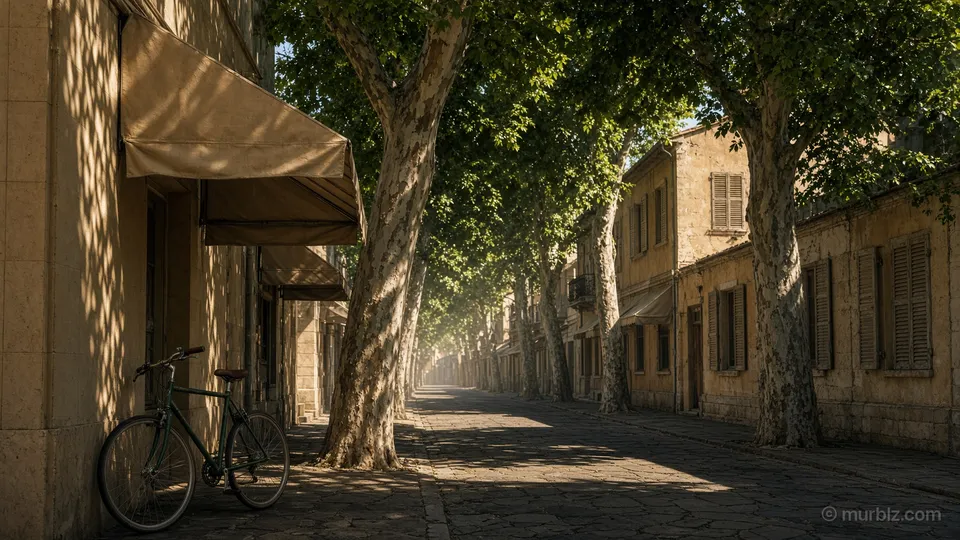
What to check in a neighborhood if you cope badly with heat:
- Distance to the sea. The breeze is strongest right on the shore and weakens further into the city, where buildings block it.
- Parks and street trees. Shade from plane trees on the pavement and a large park 5-10 minutes away make summer walks possible.
- Street width and density. The narrow streets of an old center give shade by day but cool down slowly at night.
- Orientation and floor of the flat. North- and east-facing windows heat up less, the top floor under the roof most of all.
- Air conditioning and insulation. In uninsulated buildings summer and winter power bills are noticeably higher.
Renting or buying: where a wrong neighborhood costs more
A poor choice of neighborhood when renting costs one move and perhaps a deposit. When buying it costs much more. Taxes and fees paid on purchase are not refunded when you sell. In Catalonia, for example, a buyer of a resale home pays a 10% property transfer tax on prices up to $680,000 (600,000 euros). Selling quickly and without a discount in an area where you yourself did not want to live is hard too.
So the order is almost always the same: first rent for 6-12 months in a neighborhood chosen by the numbers, and only then buy. In a year you see the area in heat and rain, in season and out of season, on weekdays and holidays. If everything fits, buying in the same neighborhood becomes an informed decision.
Before buying, check the property's legal title and building permits: in southern Europe there are extensions and even whole houses without legal registration. This is a job for a lawyer, not for the seller's agent.
We will check your documents before you apply
We find weak spots in advance so you are approved the first time.
How to check a neighborhood in one week
The figures narrow the choice to 2-3 neighborhoods. Then you need a week on the spot. This plan helps you not to miss the main things:
- Friday night. Walk the street at 11 pm and at 2 am: bars, terraces, groups, garbage trucks.
- A weekday morning. Rush hour, schools, delivery vans, traffic outside the door.
- A hot day. Walk from the flat to the metro at 3 pm and see whether there is shade on the way.
- Everyday errands on foot. Supermarket, pharmacy, market, health center, nursery or school: time each walk.
- The trip to work, the airport and the station. At rush hour, not on the map.
- The entrance and the neighbors. Who lives in the building: families, students, holiday flats. Key boxes for tourists by the door are easy to spot.
- Internet in the flat. Whether the building has fiber: for remote work this small thing is decisive.
- Car and water. What a garage space costs and whether you can park near home in the evening. After heavy rain, check whether water stands in the lower streets and basements.
- City hall documents. Noise map, zoning plan, future building sites and new transport lines nearby.
How to compare neighborhoods of a city by the numbers
A comparison is fair when every neighborhood is on one scale. This is how we do it. Each sign becomes the neighborhood's position within its own city: 100 is the best in the city on that sign, 0 the worst. Then we multiply by how much the sign matters to you, from 0 to 3, and add up. Must-haves such as a budget or a metro station nearby do not add points, they remove unsuitable neighborhoods from the list.
Two details make this comparison reliable. If a neighborhood has no data for a sign, the sign is left out of its score instead of counting as zero: otherwise an area with a gap in the statistics would lose unfairly. And neighborhoods of different cities are not put on one scale: comparing incomes in Barcelona and Tbilisi directly makes no sense.
This is how our neighborhood finder works: 73 neighborhoods of Barcelona, 21 districts of Madrid and 24 parishes of Lisbon, compared on rent, noise, green space, schools and transport. Pick a goal such as family, remote work or retirement, and the areas are ranked by how well they match.
Our guides help you choose the city, with rent, cost of living and neighborhoods: Barcelona, Madrid, Valencia, Lisbon, Porto, and the rest in the city catalog. Once the city and neighborhood are chosen, status and taxes remain: for remote workers there are the Spain digital nomad visa and the Portugal digital nomad visa.
Want to compare 2-3 neighborhoods for your family and budget? Ask a manager which neighborhoods suit you, and you will get an answer based on figures, not advertising.
Confidence in your choice: when to stop searching
The perfect neighborhood does not exist, and the search for it can last for years. The world has too many good places, and a move feels like a decision for life. Hence the constant feeling that a better option exists somewhere.
The feeling fades once you know why you chose this neighborhood. Your own list of criteria, figures for it, a week on the spot and a year of renting before buying: after that path there is little doubt left. And if after a year the area stops suiting you, the freedom to work from anywhere lets you move again, this time with a far more precise list.
We will help you choose a neighborhood and move
Murblz helps with the whole move: we choose the country and residence permit, calculate taxes, compare a city's neighborhoods against your criteria and, with partners on the ground, find housing and a school. Residence permit, tax residency, bank accounts, housing and school come together in one plan, with every step in the right order. More in the relocation support section.
Start with a free consultation in the chat on the site: a manager will ask about your work, family and budget and suggest 2-3 neighborhoods in the city you want. Details are with the manager. Get a free consultation.
FAQ
How do you choose a neighborhood to live in abroad?
Does the neighborhood matter more than the city?
Which neighborhoods should you avoid?
Where do most foreigners live in Barcelona?
Can you check noise before renting a flat?
How much does temperature differ between neighborhoods of one city?
Should you buy a home right after moving?
Which neighborhood is best for remote work?
How do you know a neighborhood suits a family with children?
Don’t want to figure this out alone?
We handle the whole process end to end: we check your documents, match a program to your situation and give you honest timelines and costs. Ask your question in the chat: the free consultation starts right here. Legal representation before authorities and courts is handled by Murblz specialists together with locally licensed partners.
The Murblz consultant replies straight away in the chat on this page. Describe your situation and we will work it out together.
Free consultation